Transcript
Announcer:
You’re listening to VacciNation on ReachMD, and this episode is sponsored by CSL Seqirus. Here’s your host, Dr. Brian McDonough.
Dr. McDonough:
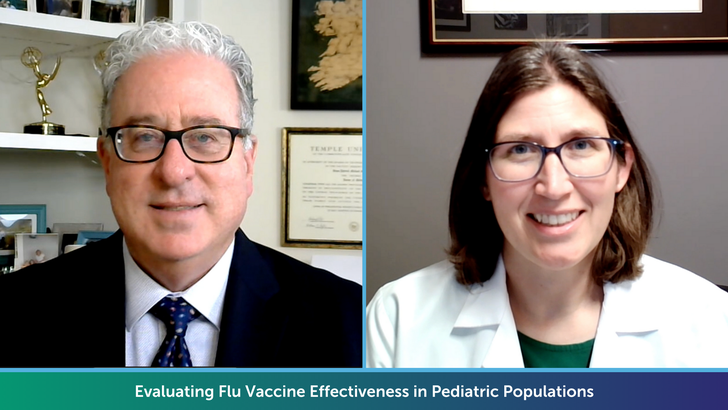
This is VacciNation on ReachMD, and I'm Dr. Brian McDonough. Joining me to discuss recent data on influenza vaccine effectiveness and how we can apply it in pediatric care is Dr. Danielle Wales. Not only is she a Clinical Associate Professor at the University at Albany College of Integrated Health Sciences, but she's also a faculty member of the Albany Medical Center's Division of Internal Medicine and Pediatrics in Cohoes, New York. Dr. Wales, welcome to the program.
Dr. Wales:
Thank you so much for having me today.
Dr. McDonough:
Before we dive into the data, Dr. Wales, let's start with some context. Why is it so important to keep evaluating how well flu vaccines work in children from season to season?
Dr. Wales:
Absolutely. So every year we know the flu usually has minor mutations. Every few years, it has a major mutation, and it's important for us to keep up with those mutations so we can best tailor our flu shots to what's actually circulating and provide us with better vaccine effectiveness.
Dr. McDonough:
Now, recent research presented at the Michigan Society of Health-System Pharmacists 50th Annual Meeting showed that cell-based flu shots demonstrated superior effectiveness compared to the traditional egg-based shot in the 2022 to 2023 flu season, as they had a relative vaccine effectiveness rate of 7.7 percent. Why is that difference important when we're talking about pediatric protection?
Dr. Wales:
There have been some seasons where the effectiveness in egg-based vaccines has been less than in the cell culture-based vaccines. And in those years where there have been egg-based mutations that prevented us from getting the vaccines that worked as well, sometimes that benefit in a cell culture-based vaccines can make a big difference, especially if spread over a large portion of the population.
I do encourage all my colleagues, though, to think about the best flu shot that a patient gets is the one that actually gets in the arm. So it's important to always know that patients every season should get the flu shot. And hopefully as time goes on, we'll continue to build better flu shots that work for everyone.
Dr. McDonough:
The research also showed that A(H3N2) predominated the 2022 to 2023 season, and that egg-adaptive mutations were identified in all four egg-based vaccine strains. So how might this data influence the way we think about the effectiveness of vaccines for pediatric patients?
Dr. Wales:
So we do know that some years, like you said, the egg mutations do affect the egg-based vaccines, and that can be important. Those years, it's not that the vaccines have no effectiveness; they have some effectiveness. It's great if kids get the cell-based vaccines if they're available. And I think it all depends on what's available at their pediatrician's office. Like I said, I think the best shot that kids will get is the one that actually gets in their arm, or alternatively, up their nose too.
Dr. McDonough:
For those just joining us, this is VacciNation on ReachMD. I'm Dr. Brian McDonough, and I'm speaking with Dr. Danielle Wales about how recent research can help inform pediatric flu vaccine decisions.
So Dr. Wales, now that we've discussed some important datapoints on vaccine effectiveness, let's shift gears and talk about how we can apply this evidence in practice. What are the main factors you consider, whether it's a child's health status, timing within the flu season, or family concerns when making decisions about pediatric vaccination? And how does this data help inform those choices?
Dr. Wales:
Sure. So first of all, I'm universal. In our practice we recommend the flu vaccine for all patients six months and above. And in my practice, I do medicine and pediatrics, so I'm taking care of a lot of parents as well. And we talk about having a vaccinated family, not just a vaccinated patient. So it's important for everybody in the family to be vaccinated.
And the child can be healthy. I mean, this season we saw almost 200, if not more, pediatric deaths due to influenza, which was a quite awful season. A lot of those kids were healthy before they got the flu. So although it's important for kids with underlying medical issues to get the vaccine, it's also important for healthy children to get the vaccine too.
I especially stress it if kids may be in contact with other kids, for example, kids in daycare, since we know that some kids may be exposed a bit more easily. If they're at home with other family members who might be at risk for the flu, we talk about getting everyone vaccinated at home. But in essence, again, I encourage every family member who's six months and above to get the vaccine.
Dr. McDonough:
And I think you mentioned it—you alluded to it for a little bit—about the fact that you deal with children and also adults. And some pediatricians who really just deal with children also vaccinate adults. Tell me how that works.
Dr. Wales:
Absolutely. So in my practice, since we are a medicine-pediatrics practice, a lot of my parents are actually patients of our practice as well, and so we offer them the flu vaccine when their kids are coming in for the flu vaccine. And that's a great experience. The kids also see their parents modeling healthy behavior, and that's a great chance for the parents to get it.
In certain areas, some pediatric practices actually do give flu vaccine to their parents as well, and they set up accounts for them and then bill the patient's insurance.
Dr. McDonough:
And when we're talking about flu shots with parents, how can we frame vaccine effectiveness data in a straightforward and comprehensive way?
Dr. Wales:
So I encourage parents to get the vaccine. I tell them, this is the same thing I'm doing for my own kids. I think parents really feel that you do the same thing for their own family members.
So we know that vaccine effectiveness—it doesn't sound great when a vaccine may only be 50 percent effective—but the point is, 50 percent is a lot when it talks about keeping kids out of hospitals, keeping kids out of urgent cares or emergency rooms. I usually tell parents, 50 percent doesn't sound like a lot, but it makes a big difference. That's 50 percent less time spent in a hospital, that might be 50 percent time less spent in a doctor's office, that's 50 percent time less spent in an urgent care or an emergency room, that's 50 percent less time that you might need to take off from work. And we all know how hard it is to take off from work. It means other family members may not get exposed to it. That adds up over time. And quite honestly, when kids get sick from flu, they can be pretty miserable for a while.
Even if your child got the flu and had the flu vaccine, they likely are not getting as sick as they would have without the flu vaccine, and that means you can get to work earlier and they can go back to school earlier. These are all meaningful outcomes. And so the point is not just to look at the number, but kind of look at the big picture.
Dr. McDonough:
Vaccines often are a target in certain groups, and obviously it goes back and forth, but without dealing with that issue, I know that some of the antivirals, especially when it comes to the flu, have been at least said to be associated with neuropsychiatric problems in patients. But is that the case?
Dr. Wales:
So it's a great question, because there is new data that came out about this in the journal, JAMA Neurology—so fairly prominent journal—and they were looking at the neuropsychiatric side effects. And what they determined was actually the neuropsychiatric side effects occurred because of the flu virus, not because of the antiviral oseltamivir. And so this is what a lot of physicians had suspected over the years, is that it wasn't the medication causing it, it was the actual flu virus.
This speaks to how dangerous the virus can be. It can cause these major side effects—neuropsychiatric side effects—and really speaks to what efforts need to be done in terms of prevention, and that includes the flu vaccine.
Dr. McDonough:
As we come to the end of our program, Dr. Wales, what are the most important takeaways from this research that we should keep in mind for the next flu season?
Dr. Wales:
Absolutely. So every year we're trying to build a better flu vaccine, and that work should continue. There's always that thought of, will we ever make it to a universal flu vaccine? And one can only hope that there's research going into that as well. That makes our job easier as clinicians.
We need to always know which flu strains are going around, especially with the threat of H5N1 in the background, so we always worry about the next big antigenic shift that we see. So we hope that the data is still able to keep up with this every year.
Dr. McDonough:
With those key takeaways in mind, I want to thank my guest, Dr. Danielle Wales, for joining me to discuss the effectiveness of flu vaccines in pediatric care. Dr. Wales, it was great having you on the program.
Dr. Wales:
Thank you so much.
Announcer:
You’ve been listening to VacciNation, and this episode was sponsored by CSL Seqirus. To access this and other episodes in our series, visit VacciNation on ReachMD.com, where you can Be Part of the Knowledge. Thanks for listening!